The Smell Before the Last Stroke
There's a specific smell that comes off a painting when it's close to done. Not finished — close. Linseed oil warming under studio lights, pigment settling into the weave of the canvas. It's different from the smell at the start, when everything is wet and sharp and a little aggressive. By the end, it's softer. Almost sweet.
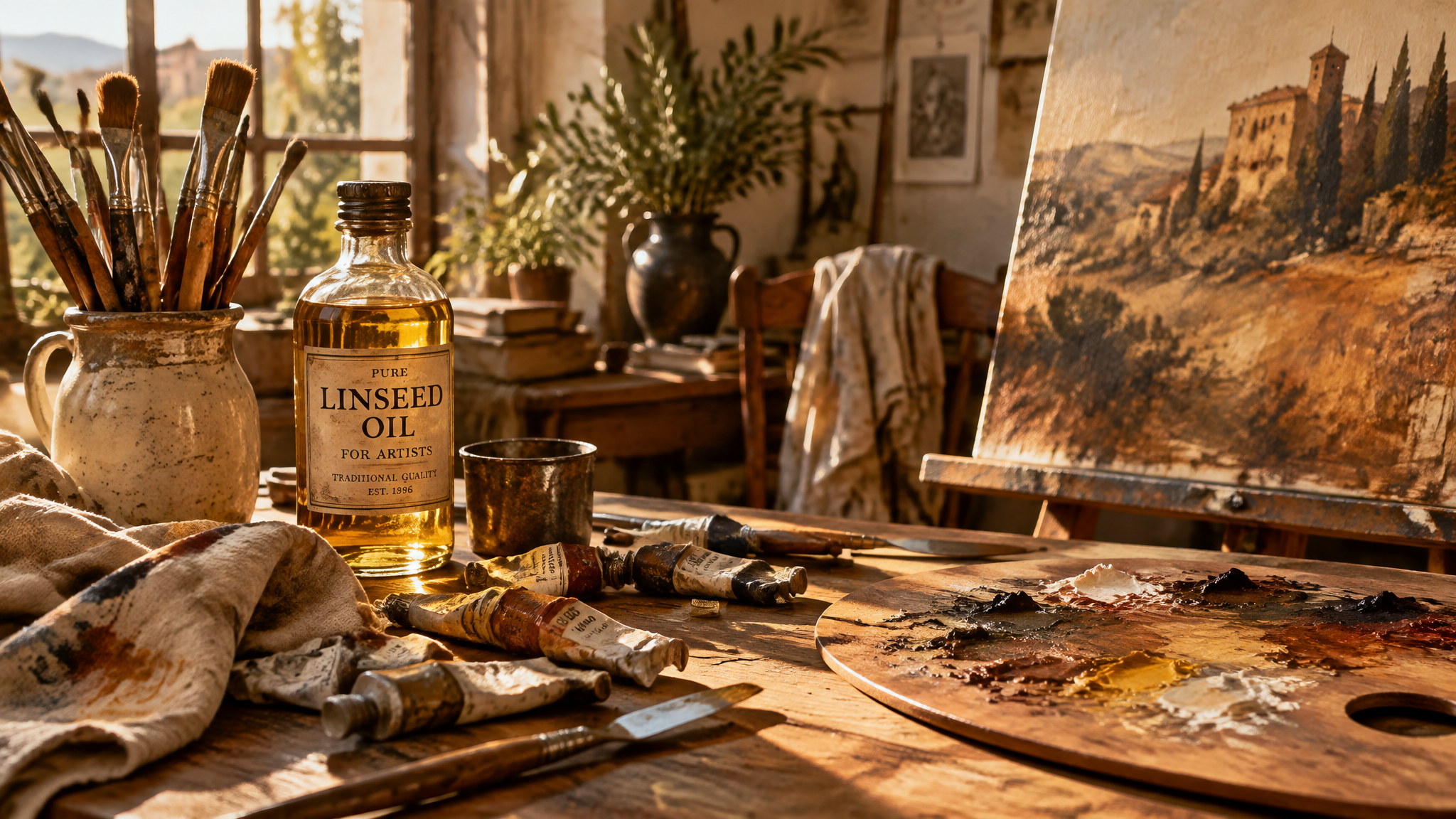
I've been painting in oils for eleven years and I still can't fully explain it. But I know it when I smell it. It means I'm almost there.
What Linseed Oil Actually Does
Linseed oil is a drying oil — it doesn't evaporate, it oxidizes. That's the technical part. What that means in practice is that the smell changes as the painting cures. Fresh linseed has a grassy, slightly fishy quality that most people find unpleasant. Refined linseed is cleaner. Stand oil is thick and slow and smells almost like honey left in a warm car.
The smell you get at the end of a session — when you've been layering for hours and the studio has warmed up — is a combination of all of them. The pigments contribute too. Burnt sienna smells different from titanium white. Prussian blue has a faint metallic edge. Cadmium yellow, if you're still using it, smells like nothing and everything at once.
I've read about fine art process from a lot of angles, and the sensory dimension is almost always left out. Technique gets documented. Color theory gets documented. The smell of a painting at 4pm on a Thursday when you've been working since 9am — that doesn't make it into the books.
The Texture Underneath the Smell
When a painting is almost done, you can feel it too. The surface has a different drag. Early layers are tacky in a way that resists the brush. Later layers, once the underpainting has cured, have a smoothness that lets you move paint around without fighting it. The brush glides differently. You can feel the painting accepting what you're giving it.
That's when I know. Not from looking — from touching. From the resistance in my wrist.
I've talked to other painters about this and they all have their version of it. One friend who does large-scale abstracts says she knows a painting is done when she stops wanting to fix it. Another, who works in the field research tradition of painting on location, says he knows when the light changes and the painting still holds. Everyone has a different signal. Mine is the smell.
Why Almost Done Is Different From Done
There's a gap between almost done and done that I've learned to respect. It's not a small gap. Paintings that I've pushed past the almost-done stage — trying to add one more thing, fix one more edge — often end up worse. The oil gets overworked. The surface muddies. The smell changes again, back to something sharper and more anxious.
The creative community talks a lot about knowing when to stop. It sounds like advice. It's actually a skill, and it takes years to develop. You have to learn to trust the signal — the smell, the drag, the way the light hits the surface — over the voice that says it needs more.
Most of the time, it doesn't need more. Most of the time, the painting is telling you something and you're not listening.
The Studio at the End of the Day
By late afternoon, the studio smells like a painting that's been worked. Linseed and turpentine and something warmer underneath — the accumulated heat of the day, the pigments that have been opened and closed, the rags that have absorbed everything. It's not a clean smell. It's not supposed to be.
I've come to love it. It means something happened here. Something got made, or almost made, or tried to be made. The smell is the evidence.
When I leave the studio and come back the next morning, the smell has changed again. Cooler. More settled. The painting has been breathing overnight. Sometimes I walk in and know immediately that what I left is done. Other times I walk in and see exactly what it still needs.
Either way, I start by smelling it. That's where the information is. More than the image, more than the composition — the smell tells me where the painting is. And from there, I know what to do next. Or what not to do. Which is usually the harder lesson.
More on texture, material, and the physical life of painting at Brushed Past.